Tuesday, January 18, 2011

The Practical Pantry: How much?

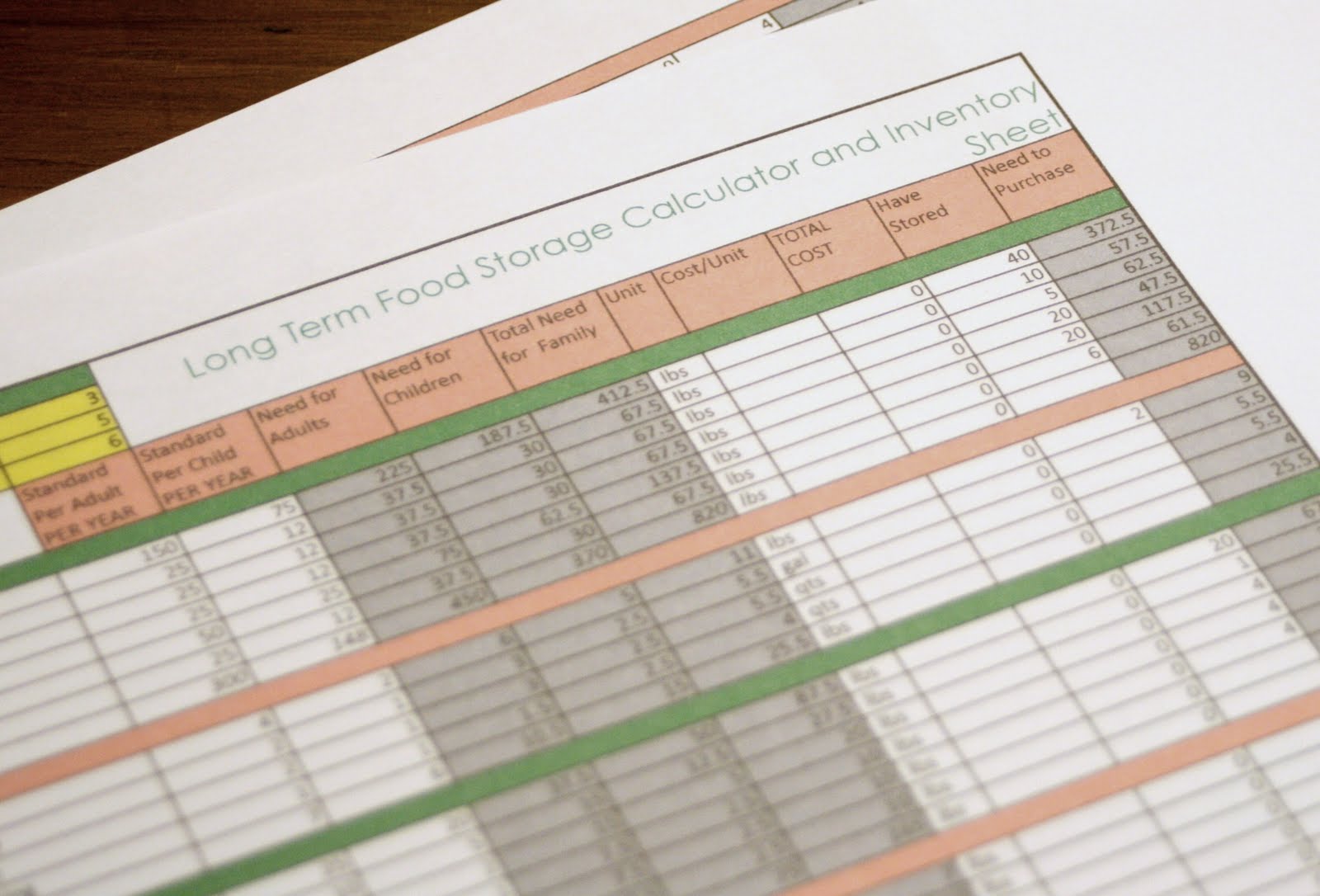
Food Storage Calculator and Inventory Sheet

Goals are pretty common this time of year and I have been fleshing out a goal of mine that has been floating around my head for a while now. In the time since I started keeping a pantry I have wanted to have several months of food for our family stored. The planning of this is what has always stumped me. How in the world do you know how much food your family would need for six months? Because of this, my focus has been on storing a few of our favorite things or a particular item we use a lot. Diced tomatoes are purchased by the case. Wheat comes in fifty pound bags. Every summer I can two bushels of peaches and all the tomatoes our neighbors can't use. I can several kinds of pickles, sweet pickles for potato salad and kosher dill pickles for eating with burgers or sandwiches. Just so you know, they are killer dill pickles. But this has been the extent of our bulk storage.
That is until recently when I discovered Food Storage Calculators online. My favorite is from this food storage blog. They created an Excel document that allows you to enter in the number of people in your family and the number of months you want it to calculate and it gives you amounts you need to purchase based on the recommendations for the average adult and child. It is customizable as far as the items to enter, for example, it listed shortening and I don't use shortening so I changed that to butter. I switched powdered eggs for ground flaxseed and dry soy beans for adzuki beans (Just tried them and we love them. They cook in the same amount of time as brown rice!). You can also adjust the amounts you want. We don't drink a ton of milk so I dropped the amount for powdered milk down. I added on canned fruit, applesauce, cocoa, raisins, nuts, coffee beans and tea.
You can print this list as an inventory of your pantry and also use it to help you decide what to purchase next. It can be pretty intimidating but taking it in steps and finding good sources of bulk foods will make it much easier. I am working toward a six month supply of food for our family so numbers like 400 pounds of wheat, 137 pounds of rice, 6 gallons of oil and 110 pounds of sugar are a bit overwhelming. At the same time it gives me a concrete idea of what to aim for. You may be considering two weeks worth of food or one month's worth. It is recommended that we all keep three weeks worth of food for our families. Well, just plug your numbers into the spreadsheet and let it do the math for you. Try to think of everything you use to feed your family and add that to the list. Whenever you purchase something, plug that amount in and it will tell you how much more you need to buy to meet your total need for that item. It's pretty awesome! At least for a food nerd like me it is.

Friday, January 14, 2011

The Practical Pantry: What?

Hard red wheat.

What's for dinner? How many times have you heard that? And that question, my friend, is exactly what you want to ask yourself as you begin to stock your newly-found and/or organized pantry.
The next step in the process is to take a good look at what you and your family eat. What your favorite meals are, what are your comfort foods, what is your fall-back meal when you have one of those days where food is the last thing on your mind.
You may want to write down some ideas. Make a list of your top five breakfasts, lunches, dinners, snacks and desserts. Dessert is very important to me, by the way. I made up a list of our favorite meals, and not just the main dish, the complete meal. That meal list is the basis for my menus. It helps us not get in a rut and helps me control my urge to cook new recipes all the time. It's a problem folks, new recipe addiction.
After you work up a list of what you like to cook and your family likes to eat, think through each recipe and see what parts of it are non-perishable items that you could stock up on. Are there acceptable substitutions you could make for some of the perishable ingredients that could be part of your food storage pantry. Say, dry milk for fresh milk in your famous Saturday morning pancakes. These ingredients should be the start of your food storage. You want to store what you eat and also eat what you store.
It's very important that you invest your money in things you know you will use. Buying five pounds of garbanzo beans isn't a good plan if nobody in your family can tolerate them. In a time of stress or crisis when you could be relying heavily on your food storage, you would need food that is familiar and comforting to your family. During a crisis is also not a good time for you to try to figure out the best ways to cook millet.
Another easy way to figure out what you should be stocking up on is to think about what you run out of the most. I am constantly running out of flour. As you can see in the photo, I buy wheat to grind but I still use a lot of unbleached white flour. So instead of buying one bag when I go to the store, I pick up two bags. Every time I go to the store I'll buy two bags until I have the amount I need. Then whenever I open a bag, I know to buy a replacement bag the next time I'm at the store. Now, this isn't the ideal way to go about it. I'm sure it would be cheaper per pound to find a bulk source of flour I like and buy that way but it's a trial and error, baby-step kind of process.
So, put on your thinking cap and sit down with some paper and a pen and start on a strategy for beginning your pantry. Remember to focus on familiar foods. If you want to try something new, buy a small amount to experiment with and see if you want to incorporate that item into your meals and pantry. Like I said, it can be a slow process but each time you can add a bag of beans or an extra jar of applesauce to your pantry you'll find that the satisfaction of having food stored in your cupboard is well worth all the time and effort.


Friday Photo

My favorite bouquet, fresh Italian parsley. One bundle of fresh parsley from the local grocery store resides on my kitchen windowsill, brightening up a gray winter landscape. Later a handful of the same parsley brightens up a bubbling dish of scalloped potatoes at our dinner table. You can't beat that with a bouquet of roses, can you?

Monday, January 10, 2011

The Practical Pantry : Where?

Dill pickles, sweet lime pickles and pickled jalapenos in my pantry.

"Where in the world would I put all that food?" There you have it, the burning question of anyone who is contemplating building a food storage pantry. You may be lucky enough to have a space just for a pantry in your home. If you're like most people, that is not the case. A significant pantry is still doable for you, you just have to get creative.

If you have a designated pantry space, for me it's a small closet off of my kitchen and laundry area, you just have to clean it out (easier said than done for me) and get it organized. A friend of mine with a very large family, has a room of her home that she set up for a pantry. It's bigger than my bedroom, perfect for her family. When her husband suffered a life altering illness and was no longer able to work she fed and still feeds her family of 10 children plus 4 grown children who visit often with their spouses and kids, from her food storage. Her years of diligence blessed their family in a tough time. Amidst all the unknowns, they knew they could eat.

I have a small space but following my friend's advice, I pulled all of my food out of my kitchen and organized it in my pantry. The only food items in the kitchen are baking supplies. This idea seemed strange to me at first but has streamlined my cooking by making all my bowls and utensils easy to reach, also I can see at a glance what I have on my pantry shelves. If this is a possibility for you, get all the food but your baking supplies in your pantry space. You'll love it!

Now, for many people this isn't an option. Rarely are new homes built with any space for storing food. Our current home is the first one I have had that has a separate space. In fact, this series was inspired by my sister and her kitchen situation. Her family is working to build up a good supply of food and they quickly ran out of cabinets. My handy brother-in-law put up shelving around the kitchen and they are using that but it is a challenge to keep organized. That got me to thinking about food storage when you don't have the storage.

One option is to use one section of your kitchen for dishes, mixing bowls, pot and pans, etc. and another section for food. By keeping it in a designated chunk of space or cabinets you can see what you have and what you need to stock up on. Another option is to look around your house and see what space could be better used for storing food. A quote I love is from Amy Dacycyzn, "Would you rent the space under your bed for $50 a month?". Under my bed I have shoes, my husband's antique shotgun he inherited from his grandfather, various toys my kids dropped down there and carnivorous dust bunnies. I could fit a lot of food under my bed. And we have two bunk beds and two cribs in our house too. You could fit some food under all those beds. A hall closet? A linen closet perhaps? There are probably lots of possibilities in your house that you never thought of.

The only caveat is that the pantry space be a consistent temperature. Food should be stored in a dry ventilated place where there isn't a big temperature fluctuation. Unfortunately this rules out the garage. So the challenge is to look around your home and scout out all the places that could be converted to food storage. You will be surprised at the space you can find to store that case of canned tomatoes or 25 pound bag of sugar or in my case, the 10 pound bag of chocolate chips. Not under the bunk beds, that's for sure!

The Practical Pantry: Why?


Before you get started on a pantry it's a good idea to think about your motivation for building a food storage pantry. For me the top two reasons are healthier eating that fits our budget and security during a crisis. Over the past year we have transitioned to all whole grains and a primarily vegetarian diet. With a family of eight this translates to a lot of wheat, rice and beans. Lots of beans. The crisis aspect became crystal clear two years ago when I was one week away from delivering my fifth baby. Our area experienced a devastating ice storm. We were without electricity for a week, some were without power much longer. This really got me to thinking about how we would have fed ourselves during this crisis if we had not been able to get to a place with electricity. Pretty solemn thought.
There are some other benefits to having a pantry that I certainly have enjoyed, one being the savings of buying our staple foods by bulk. You can see significant savings when you compare the per pound price of oatmeal at the grocery store to buying a 25 pound bag from a co-op. Another benefit is fewer trips to the store. Believe me, those cupboards have to be really bare to get me to haul everyone to the store. Now I can just go to the pantry and decide what I want to make. It may not be what I was craving or what I had planned but it's always filling and delicious. And for me, knowing that I am feeding my family the best quality of food at a much better price makes that steaming bowl of stew and bread made from fresh ground wheat even yummier.
An important thing to understand is that building a pantry is not about fear and it is not hoarding. I'm sure many of you know someone who prepared for the worst for Y2K. In fact I just used up the last of my parents soft wheat they stored for Y2K. The good news is that 12 years after they purchased it, it was still good. Properly stored food can last a long time. Many people at that time were motivated by extreme fear. You should be motivated by a desire to best feed your family and meet your budget goals.
Proverbs 21:20 says, "In the house of the wise are stores of choice food and oil, but the foolish man devours all he has." So even Solomon agreed that there is wisdom in storing food for your family to use. For me it would be hoarding if I was buying up large amounts of food when there was a general shortage. In fact that is one definition of hoarding, amassing and hiding a supply of something in a time of scarcity. However, in a time of plenty, it is common sense to plan for your family and others you may be with if there was a crisis. Crisis can come in may guises. Personal crisis such as a job loss or illness could have you relying on your food storage or any other crisis personal or more widespread. Again, you can't operate in fear, but use wisdom. Joseph in Egypt is a great example of this.
Now that some of the whys are covered and you have thought about reasons to start your own pantry we can get to the planning of it. This is going to be fun!

Friday, January 7, 2011

Friday Photo

Nesting bowls, how I love thee, let me count the ways. This complete set of vintage Pyrex was a Christmas gift from my older sister and youngest brother. Do they know me or what? I've been using them everyday and I'm not sure I'll find a place in my cabinets for them. It's much easier to grab one and mix up a batch of cornbread if they are out on the counter. And they do look striking in the afternoon sun. Don't you think?
The first installment of the Pantry Primer will be up bright and early Monday morning. I'm excited!

Tuesday, January 4, 2011

The Practical Pantry

The Pantry Primer. This idea has been in the planning stages for several months and now seems the perfect time to start a series of posts on building, maintaining and cooking from a pantry. A pantry has always been a feature of my kitchen whether it has been a few cabinets or the small closet off my kitchen that I have in our current home. I've always canned food from our garden and many years that has been the extent of my pantry. In the past few years I have been employing a strategy, a loose one but a strategy none the less, to build up and maintain a significant food storage pantry. Over the next few weeks I'll write about why our family is building up a pantry, how we are doing it and what we are doing with the food now that it's in there. Also, I want to show how you can have a pantry even if you have limited space. Join me and see if you want to have a pantry of your own. I think you will!